

Next Steps – Rebuilding Secwépemc Law
Next Steps
Rebuilding Secwépemc Law

About Next Steps

About The Project

Next Steps Rebuilding Indigenous Legal Orders: is an Indigenous-led initiative to renew and rebuild Indigenous legal orders across Canada. Drawing on the University of Victoria’s renowned legal research and education programs, the University supports nations to holistically revitalize their legal traditions.

The Secwépemc Project


Drummer

The Secwépemc Nation is one Nation involved in the National Project and was chosen by UVIC to lead the research of Secwépemc laws due to the past experience of members of the team. The research is being conducted by Secwépemc for Secwépemc. The UVIC Next Steps Secwépemc research team consists of Sunny LeBourdais, Bonnie Leonard, Julianne Peters, Mikayla Phillips and Cheyenne Gentles.

The goal of the work is to create a body of research that covers various aspects or themes in law and to make that research available to Secwépemc communities to utilize to create tools, draft laws, protocols, and other components that assist with decision-making and governance in the modern world. The Secwépemc research team are actively researching stseptékwll (oral tellings) and slexéy̓em (historical accounts), collectively referred to as tellings, as well as considering other elements and sources of Secwépemc law, such as ceremony, dance, songs and landmarks.

The Secwépemc research team hosts gatherings where Secwépemc participants are invited to learn the collected tellings and retell them in their own words in a fun, interactive way. The tellings are then considered from a high-level perspective, asking a simple question, “What is this telling teaching us?” In more detail, the Secwépemc participants are then supported by the team to deep dive into a case brief methodology, that is a structured approach to dissecting the telling into different components for the purposes of learning more details of its teachings.

The Secwépemc research team then works with Secwépemc participants on the analysis of the tellings, interpretations and teachings. That analysis forms the basis of a research report which will be made available to Secwépemc Nation members as a reference tool for creating other products, such as laws, protocols, agreements, policy, procedures, and other governance tools that are required in modern day to day society.

Shuswap Nation Tribal Council


The Shuswap Nation Tribal Council team is taking previously published research work that has been developed in the past and resharing that information with Secwépemc communities in order to put it to work. The research work that SNTC is sharing is valuable and interesting and has many uses. The research has been conducted, the reports have been circulated, now it’s time to put the research to work through implementation and tackling some of today’s issues.

How the Research Works


Secwépemc law work moves through three connected bodies of work, from research to putting law into practice.
Research Work

Secwépemc Law Research Projects

This body of work includes the research and development of new research reports through projects focussed on different areas of law (e.g. Trade & Economy, Lands & Resources, Harms & Injuries).

Mountain Landscape

Planning & Preparation for Implementation

Capacity Building

This body of work includes active engagement with Secwépemc Nation members, and groups in order to further support information and knowledge sharing about Secwépemc Law and Law work that has been completed.

Mountain Landscape

Law Development & Implementation

Operationalization

This body of work includes the active development, approval and operational implementation of Secwépemc Law. It includes the development of law including governing documents, confirmation of mandates, funding, and connections to processes.

Read The Full Overview
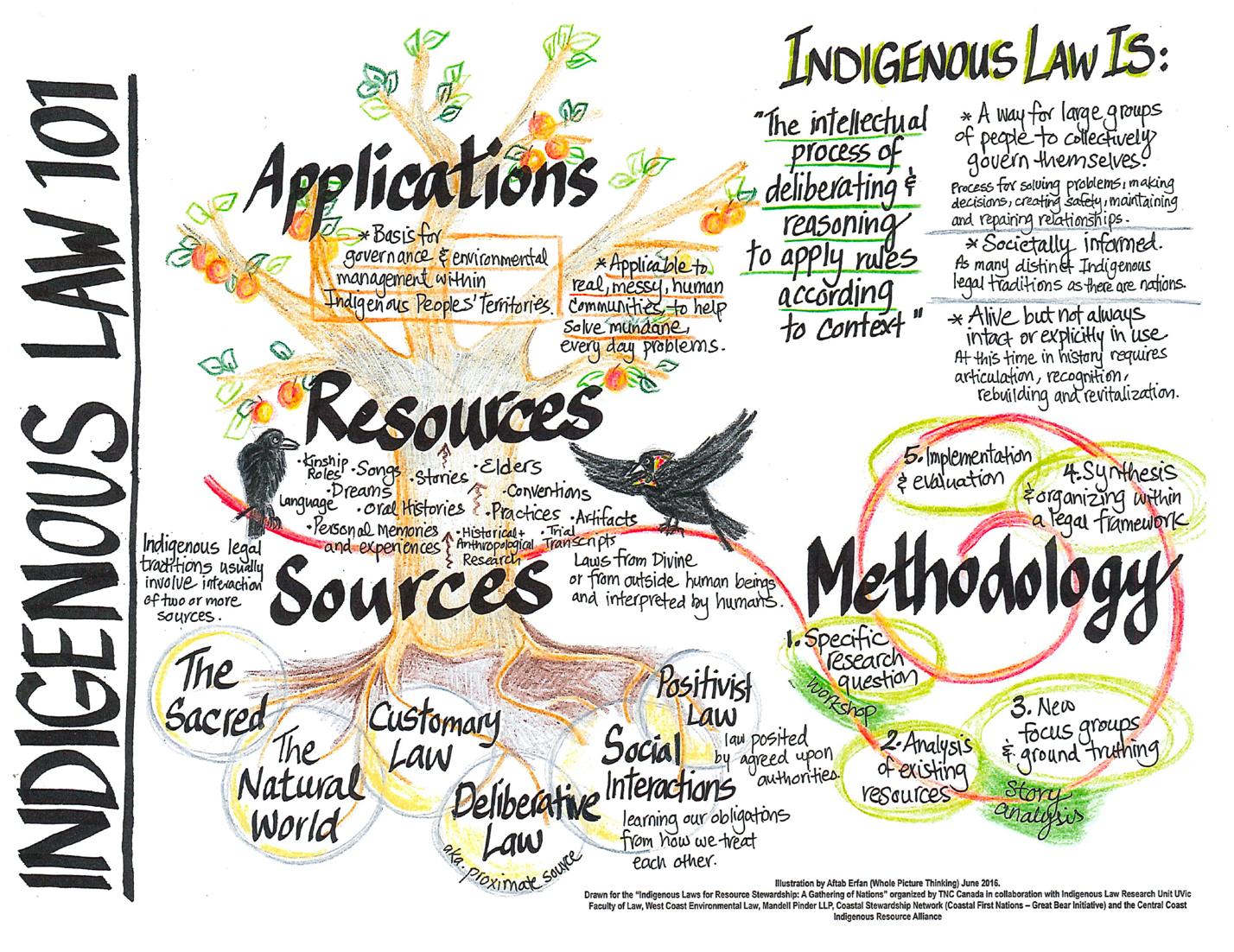
Indigenous Law 101

Indigenous Law 101. Illustration by Aftab Erfan (Whole Picture Thinking), 2016.

Understanding Secwépemc Law


A short overview of Indigenous law and Secwépemc law.

What is Secwépemc Law?

Secwépemc elders point to the concept of stsq̓ey̓ as denoting Secwépemc “laws” as marked on the land and connected to stories of the past. These oral histories derived from ancestors’ actions are the underpinnings of legal and moral codes.

We have a second concept, tk̓wenm7íple7, that is also sometimes translated as “law” by Secwépemc elders. Tk̓wenm7íple7 lays out the forward-looking way that we can enact new laws and determine what is best for us as a people.

Whereas stsq̓ey̓ reminds us of the deeds and powers of our ancestors, tk̓wenm7íple7 gives us a way forward to think of law.

What is Indigenous Law?

The internal legal systems, traditions and governance practices that Indigenous peoples developed to manage their societies, relationships and territories.

Indigenous Law vs. Aboriginal Law

Aboriginal law is made about Indigenous peoples by Canadian legislatures and courts. Indigenous laws are the rules Indigenous peoples develop for themselves, and they exist in the present, not just the past.

Facts, Fears & Fictions

Indigenous Peoples have always been lawful. You don’t have to be a lawyer to work with Secwépemc law, as it is meant to live in all of us. And you cannot break it: Secwépemc law is robust and has been adapting through time.

Secwepemctsín & Secwépemc Law

Secwepemctsín is foundational to revitalizing Secwépemc law and adds an invaluable layer of knowledge to our laws. However, Secwépemc law does not rely on your ability to speak or understand Secwepemctsín.


Read The Full Overview

Rebuilding and revitalizing Secwépemc law is all of our business as Secwépemc.